
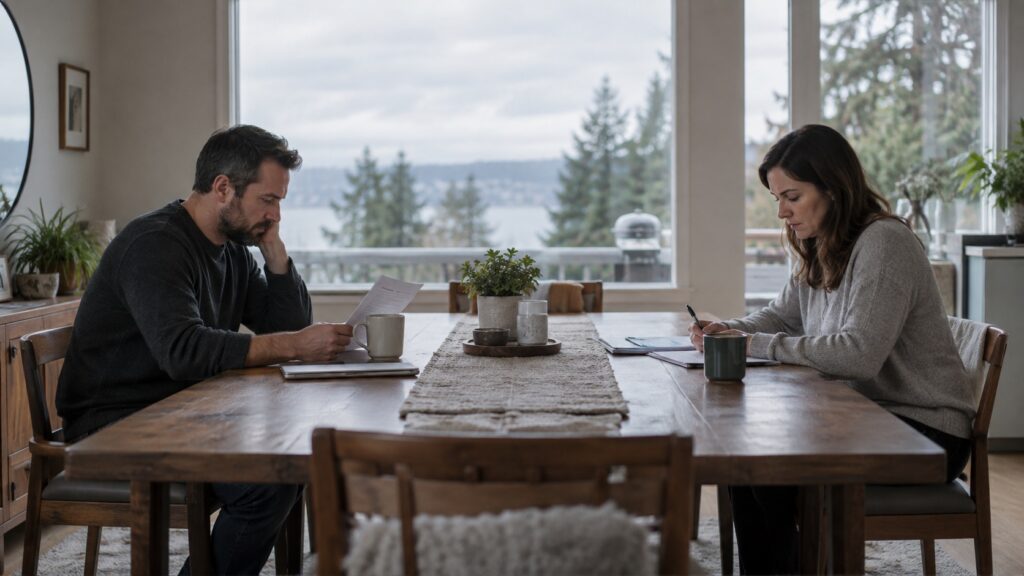
What BC law says about staying, and about being ordered out
George Lee | 李广田律师 | Barrister & Solicitor, Vancouver
Most separating couples in the Lower Mainland do not have the option of two homes. One income cannot carry a Burnaby mortgage and a Coquitlam rental at the same time. The children are settled at a school. The house is in both names and neither side will move first for fear of what moving means. So the marriage ends and the household does not.
This arrangement is legal, common, and workable for a while. It is also where a surprising number of family files go badly wrong. Here is what to know before you settle into it, and what the court can do when it stops being survivable.
You are separated even though you share a kitchen
Section 3(4) of the Family Law Act says it directly: spouses may be separated while continuing to live in the same residence. What the court looks for is an intention to separate permanently that was communicated, and conduct that matches it. Separate bedrooms. Separate finances. Separate meals and laundry. No longer appearing as a couple at family or social events. None of that is a statutory checklist — these are examples of evidence, and a judge weighs the whole picture rather than counting boxes.
The date of separation is not a formality. It is an important reference point for what counts as family property and family debt, although some debt incurred after separation to maintain family property can also count. Value is generally assessed later, at the date of the agreement or the hearing. It starts the one-year separation period that a divorce is usually based on. And it starts the two-year limitation clock — but only for unmarried spouses. For married spouses that two years runs from the divorce judgment or the order declaring the marriage a nullity, which can be years further out. Under one roof, the separation date is much easier to dispute later, because nothing visibly changed on the day it happened.
So mark it. A short letter or email to your spouse recording that the relationship is over, dated, and kept. It costs nothing now and can be worth a great deal in two years.
Write the house rules down while you are still speaking
The households that survive this period are the ones that treat it as a temporary arrangement with terms, not as a truce. Put the basics in writing, even informally:
- Who sleeps where, and which rooms are private.
- Who pays which bill, from which account, and what happens to the joint account.
- Groceries, cooking, laundry — separate or shared, and on what terms.
- A parenting schedule inside the house, so the children know which parent is on duty.
- One channel of communication for logistics, ideally written.
- No new partners in the home, and reasonable notice before guests.
Two cautions. Paying all the bills does not buy you the house, and paying none of them does not lose it. But the money moving in this period does get examined later: debt taken on after separation to maintain family property can itself be family debt, and post-separation conduct that changes the value of the property or the debt beyond ordinary market movement can feed an argument that an equal division would be significantly unfair. Keep records. And think hard before you start recording your spouse in the house. Admissibility and weight are fact-specific, and a recording can matter where safety is genuinely in issue. But in my experience, routine recording of family life carries less weight than the person making it expects, and it invites questions about the recorder rather than the recorded. Ask your own lawyer before you start.
When it stops being survivable: three different orders
Clients tend to use one phrase — "can I get him out of the house?" — for three remedies with different tests, different courts, and very different consequences.
1. Exclusive occupancy
Under section 90(2)(a) of the Family Law Act, the Supreme Court may grant one spouse exclusive occupation of the family residence for a specified period. Note the court: this order is not available in Provincial Court. The test, unchanged for decades, has two parts — that sharing the home has become a practical impossibility, and that you are the preferred occupant on the balance of convenience. Where there are children, their best interests drive the analysis.
"Practical impossibility" is a high bar. The authorities gloss it as objectively intolerable rather than merely unpleasant, and mutual dislike on its own will not carry it. But sustained conflict is not irrelevant either. Where it reaches the children, or affects safety, health, or the ability to function in the house, it can be exactly what makes shared occupation impossible.
The most useful recent illustration is Hohmann v. Hohmann, 2024 BCSC 100. The parties separated in 2015 and were still in the same rural house eight years later with five children at home, the mother sharing a bedroom with two of the boys and living on the child tax benefit while the father controlled every account. The court granted exclusive occupation, and at para. 15 made a point that matters to anyone reading this: the longer spouses have managed to live together after separating, the higher the bar becomes to prove that it is impossible.
Read that carefully, because it cuts both ways. It is an observation about evidence, not a rule, and it did not stop the order in Hohmann itself after eight years. What changed the answer there was the effect on the children rather than the unhappiness of the adults (paras. 25–32). The other detail worth knowing is the timing: the judge gave the father three months before he had to leave, so that a second residence on the property could be made habitable (paras. 37–39). Exclusive occupancy is rarely a locksmith on Friday afternoon.
2. Conduct orders
Conduct orders are the quiet workhorse of a shared-roof file, and they are available in both courts — though within a family law proceeding, not as stand-alone household management. Section 222 sets out what they are for: settling a dispute, managing behaviour that frustrates settlement, preventing misuse of the court process, and making temporary arrangements in the meantime. Section 225 lets the court restrict communication between spouses. Section 226 addresses the residence itself — requiring a party to make payments for rent, mortgage, specified utilities, taxes, insurance and other expenses, prohibiting a party from cutting off utilities, and requiring that someone supervise the removal of personal belongings. Section 227 picks up other conduct.
Two things to understand about them. Conduct orders are ordinarily not the route to removing a spouse from the home; what they do is stop the behaviour that makes staying unbearable — the cancelled hydro account, the constant messages, the unpaid mortgage. In practice they are also a good deal easier to obtain than exclusive occupancy, which is why they are worth asking about first. But where the real problem is safety, a conduct order is the wrong tool. The Ministry's own guidance is that a conduct order alone should not be used to manage a risk of family violence, because these orders are enforced through the family court rather than by the police.
3. Protection orders
Where there is family violence, Part 9 of the Family Law Act applies and the analysis changes completely. Under section 183 the court may order a family member to stay away from the residence, to leave it immediately or within a set time, and to be supervised while removing belongings. Both the Supreme Court and the Provincial Court can make these orders.
Family violence under this Act is broader than most people assume. It includes psychological and emotional abuse, and financial control. Section 184 requires the court to consider a list of risk factors: any history of violence, whether it is repetitive or escalating, whether psychological or emotional abuse forms a pattern of coercive and controlling behaviour, the recency of the separation, substance use, access to weapons, the at-risk person's own perception of their safety, and anything that increases their vulnerability — pregnancy, age, health, family circumstances, economic dependence.
Three practical points. Your own sense of danger is one of the factors the court must weigh, but it is weighed against the whole record — so bring the record: messages, photographs, medical or police reports, financial records, witnesses, and an affidavit that sets out what happened and when. Second, the fact that you stayed in the house, or went back to it before, does not bar an order, and neither does the absence of criminal charges. Third, a protection order is not just paperwork. Unless the court says otherwise it runs for a year, an officer with reasonable and probable grounds to believe a term has been breached can enforce it without proof that it was served, and a breach without lawful excuse may be prosecuted under section 127 of the Criminal Code.
That last point cuts both ways, which is why I discourage clients from reaching for a protection order as a tactic. Applying for one on thin facts, to gain ground in a parenting dispute, tends to damage the applicant's credibility on everything else in the file. Applying for one when it is genuinely needed and being talked out of it is worse. Be honest with your lawyer about which situation you are in.
Two things that are not true
Moving out does not forfeit your interest in the house. Ownership and division are decided later, on their own principles, and an exclusive occupancy order expressly does not change title. What moving out can change is the parenting pattern. The parent who stays with the children in the family home starts building a routine, and an established routine carries weight on an interim application — but it does not decide anything. The governing question remains the child's best interests, including stability, who has actually been doing the caring, and any family violence. The practical lesson is to settle a parenting schedule before anyone leaves, not to stay indefinitely in order to hold ground.
And a judge is not going to arrange your household for you. Courts make orders about occupancy, conduct and safety. They do not divide the refrigerator, referee who did the dishes, or supervise a bedroom-sharing arrangement week to week. Almost everything in the middle has to be agreed or endured.
What to do this month
- Fix the separation date in writing and keep a copy outside the house.
- Put the household terms in writing, even in a text message thread.
- Open your own bank account and get your own copies of tax returns, statements and mortgage documents while you still have access.
- Keep a short dated log if conflict is escalating. Contemporaneous notes are worth more than recollection a year later.
- Get advice on the two-year limitation period for property, pension and spousal support claims — two years from separation if you were not married, two years from the divorce or nullity order if you were. The clock can be suspended while both of you are working with a family dispute resolution professional, but do not rely on that without advice. Living together after separating makes it very easy to lose track of the date everything runs from.
- If you are frightened, say so plainly and early — to your lawyer, and if necessary to the police. Do not wait for it to get bad enough to be believed.
The last word
Staying under one roof after separating is a financial decision, and often a sensible one. It becomes a legal problem when it drifts — when no date was recorded, no terms were set, and the tension is absorbed by the children until someone finally applies to court with eight years of endurance behind them. Decide the terms while you can still discuss them. If you cannot, come and talk about which of the three orders actually fits your situation, because they are not interchangeable.
George Lee Law Corporation | 李广田律师事务所
We act for separating spouses across Vancouver, Burnaby, Richmond and Coquitlam in English, Cantonese and Mandarin. 604-681-1611 | info@gleelaw.com | gleelaw.com
For help putting shared-house terms in writing, see our BC separation agreement guide. For advice about your circumstances, contact our office.
This article is general information about British Columbia law, not legal advice, and does not create a solicitor-client relationship. Case law may be appealed or affected by later decisions. If safety or a limitation deadline is at issue, seek advice on your own facts without delay.