
A new BC Supreme Court decision gives a clear answer
George Lee, Barrister & Solicitor | September 2026
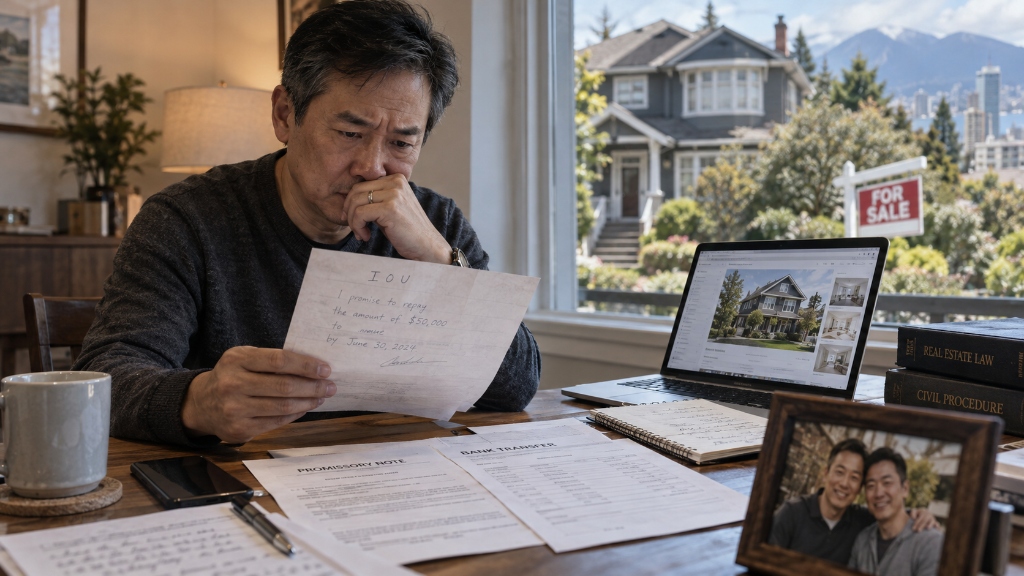
The Sunday phone call
The call often comes on a weekend. The voice is tense.
“George, I lent my old friend money. Years ago. He always paid the interest. Now he has stopped. And I just saw his house on MLS. Can I put a lien on it before he sells?”
I understand the fear. The friend is from your hometown. You trusted him. You have an IOU in a drawer and a row of bank transfers on your phone. Now his biggest asset is about to turn into cash. Cash can move. Cash can leave the country.
So you want to freeze the house. Today.
A decision released on September 18, 2026 shows why that instinct can backfire.
The myth: “He owes me money, so I have a claim on his house”
Many people believe three things.
- If someone owes you money, you can put a hold on their property.
- A certificate of pending litigation — a “CPL,” often loosely called a lien — is how you do it.
- It is smart to file first and sort out the details later.
In an ordinary loan case, all three are wrong. And the third one is expensive.
The legal truth: a loan gives you a claim to money, not to land
In BC, a CPL is registered under section 215(1) of the Land Title Act. It is available to a person who is “claiming an estate or interest in land.”
That is the key. A CPL protects a claim to the land itself. It is not a debt-collection tool.
When you lend money without security, you become a creditor. You are owed money. You do not own any part of the borrower’s house. If you win in court, you get a money judgment — not a piece of the property.
There are exceptions. You may have a real claim to an interest in land if:
- the loan was secured by a mortgage on the property;
- the loan agreement gives you an enforceable security interest in that specific property — for example, a written agreement to charge that property as security;
- you can show — with facts — that your money actually went into the property and why money alone would not make you whole, supporting a constructive trust; or
- your contract is about the transfer of the land itself, such as a claim for specific performance.
Without one of these, a CPL is on thin ice.
The two-part rule for a constructive trust
Most lenders who register a CPL rely on a constructive trust. They say, in effect: “My money is in that house, so part of the house is mine.” BC courts repeat the same rule again and again. Your claim must plead facts that meet both parts:
- Part 1 — a link to the land. A direct link, causal connection, or nexus between your claim and the property. This is what makes it a claim to “an interest in land.”
- Part 2 — money is not enough. Facts showing why a money judgment would be inappropriate, inadequate, or insufficient.
Both parts are required. A strong story on Part 1 does not rescue a bare assertion on Part 2.
The case: Chen v Zeng, 2026 BCSC 1776
The facts
Two couples knew each other from China. The husbands had been friends since childhood. From 2015 to 2021, Mr. Zeng borrowed RMB 1,150,000 — about $222,000 — from the Chens. The loans were payable on demand at 12% interest a year. He signed a series of promissory notes, the last ones in 2021.
For years, he paid the interest. Then, in early 2025, trouble started. He wrote a note admitting the debt but cut the interest rate on his own. The Chens heard his company in China could not pay its bills. Then they learned his Vancouver home was listed for sale.
The Chens sued and registered a CPL against the house. They said the loan money had been used to buy the home and pay the mortgage.
To close the sale, the Zengs paid $265,000 into the Chens’ lawyer’s trust account as security. The CPL came off title. The payment was “without prejudice” — no admission that the CPL was valid. The Zengs then asked the court to declare the CPL invalid and give the money back.
What the court decided
Justice Jahani declared the CPL invalid and ordered the $265,000 returned to the Zengs “forthwith.” The court also said the Zengs should have their costs of the application.
Why
At this stage, the court does not weigh the evidence. It asks one question: does the claim, as written when the CPL was registered, disclose a claim to an interest in land? (Bilin v Sidhu, 2017 BCCA 429.) Here, the answer was no. The claim failed both parts of the rule — and the lenders’ own words made things worse.
- Part 1 failed: no money trail. The house was bought in November 2015, eleven months after the first loan. The claim did not say how much of the loan went into the purchase or the mortgage, or when. It said money moved from China to Canada, with the details “unknown.” The judge called that speculation.
- Part 1 failed again: nothing in the loan papers about the house. A loan contract does not create a property claim unless it says so.
- Part 2 failed: no reason why money was not enough. The claim simply said damages were inadequate, “particularly” because the Zengs were selling the house to move the proceeds out of the court’s reach. In a loan case, the judge held, that bare assertion is not enough. The claim had to give some basis for why a money award would not do, or why an interest in the property was appropriate.
- The lenders’ own words gave them away. They asked the court to order the house sold if the debt was not paid. That showed they wanted security for a debt — not the house itself (citing Goel v Dhaliwal, 2022 BCCA 87).
Why the fraud cases did not help
The lenders argued that recent cases have softened Part 2. They relied on Batth v Sharma, 2024 BCCA 29, and Wu v Xiao, 2021 BCSC 1692. The judge distinguished both:
- In Batth, the Court of Appeal did not specifically decide whether the “money is not enough” pleading was sufficient. The pleadings there linked the fraudulent use of the plaintiffs’ money to the property, and showed the defendants could not pay a money award.
- Wu involved fraud, breach of trust, and misappropriation of funds. And the defendants there did not argue that the pleading failed to disclose a cause of action.
An ordinary unpaid loan is different. When a borrower simply fails to repay, you must still meet Part 2. Saying “they might sell and move the money” is not, on its own, enough.
The judge relied on a line from an earlier 2026 decision: a CPL is “not to be used as a pre-judgment execution for a purely financial claim” (Boston Development Corp. v Takhar, 2026 BCSC 784).
The twists
Twist one: the Chens did not lose their debt claim. The court made no finding that the money is not owed. They lost their grip on the house, not their lawsuit.
Twist two: the court understood the fear. The judge acknowledged that the lenders may not have known the details when they sued. But not knowing does not justify registering a CPL too early.
Twist three: “without prejudice” mattered. Because the Zengs paid the $265,000 without admitting anything, the money had to go back once the CPL fell.
A companion case: a different way to lose a CPL
Eight days earlier, in Lewis v Ball-Prevedello, 2026 BCSC 1809, a different judge dealt with a CPL in a family case. This was not a challenge to whether the CPL was valid. It was an application to cancel the CPL for hardship and inconvenience under section 256 of the Land Title Act, with section 257 governing the security the court can order in its place.
Those sections let an owner ask the court to cancel a CPL — even a properly registered one — by proving “hardship and inconvenience.” The hardship must be real and caused by the CPL alone. It must be more than trifling, though the court should not be exacting (Save-A-Lot Holdings Corp. v Christensen, 2023 BCCA 35). If the owner passes that test, the court decides what security should replace the CPL, and it can weigh how strong the claimant’s case is.
In Lewis, the claimant said she and the owner were common-law spouses, and that she had helped renovate the house. The owner showed the CPL was blocking the second mortgage he needed to complete a condo purchase, putting his $29,250 deposit at risk. He had not yet been refused a mortgage. But hardship that is likely is enough, and the judge found it here. On the evidence heard so far, her claim to an interest in the house looked weak, and money damages would be an adequate remedy. So the judge cancelled the CPL and replaced it with the owner’s signed undertaking to pay any damages she later proves.
Put the two cases side by side:
- Chen v Zeng (s. 215): Was the CPL ever valid? No — the claim did not disclose an interest in land.
- Lewis v Ball-Prevedello (ss. 256–257): Even with a claim on the table, should the CPL stay? No — real hardship, a weak claim, and money damages adequate.
The lesson is the same. A CPL is a strong tool for a real claim to land. It is a poor tool for anything else — and even a proper one can be swapped for a promise to pay.
What you should do instead
Before you lend
- Put it in writing. Amount, currency, interest, when it is due, and signatures. An IOU proves a debt. It does not give you security.
- For a large loan, take a mortgage and register it. A registered mortgage gives you security against the property and a place on title — subject to any interests already registered ahead of you. An IOU gives you neither.
- Say what the loan is for. If the money is to help buy a house, write that down — and keep proof of where it went.
- Keep the money trail. This matters even more when funds move from China to Canada. In Chen v Zeng, the cross-border link was the weakest part of the claim.
After the borrower stops paying
- Make a written demand. Keep a copy.
- Watch the clock. BC’s Limitation Act sets tight deadlines — generally two years. For demand loans, timing can turn on when you made demand, and a signed written acknowledgment of the debt, or a part payment, can restart the clock. Get advice early.
- Sue for the debt. That is your core claim.
- If assets are about to vanish, ask about a Mareva injunction. It is a court order that freezes assets. The bar is high: you need a strong case and real evidence of risk, and you must promise to pay damages if you turn out to be wrong.
- Ask about pre-judgment garnishment. In some qualifying debt claims, BC law lets you garnish money owed to the borrower, including certain bank accounts, before trial.
- After you win, register your judgment against the borrower’s land. The judgment then becomes a charge on the borrower’s interest in the property, subject to the usual priority rules — generally behind mortgages registered before it. It does not pay you automatically, but the borrower cannot sell or refinance cleanly without dealing with you.
What not to do
Do not register a CPL as a shortcut on a plain loan claim. If it falls, you may have to return any security, pay the other side’s costs, and start again — with less leverage than before.
A friendship loan is still a loan
Lending to a friend is an act of trust. Protecting yourself is not an act of distrust. It is good sense — for both of you.
If you are about to lend a large sum, or a friend has stopped paying you back, talk to a lawyer before you act. The right step at the start can save you years and a great deal of money.
Call George Lee Law at 604-681-1611 or email info@gleelaw.com. We serve clients in English, Cantonese, and Mandarin.
This article provides general information, not legal advice. Every case turns on its own facts. Chen v Zeng and Lewis v Ball-Prevedello were released in September 2026 and may be appealed; check their current status before relying on them.